
Spend the £1,000 on lunches.
What I told the opening panel at the first Racket Sports Business Expo about AI, follow-up, and the WhatsApp group your club already runs.
Ross Thornley · Founder, PADEXA
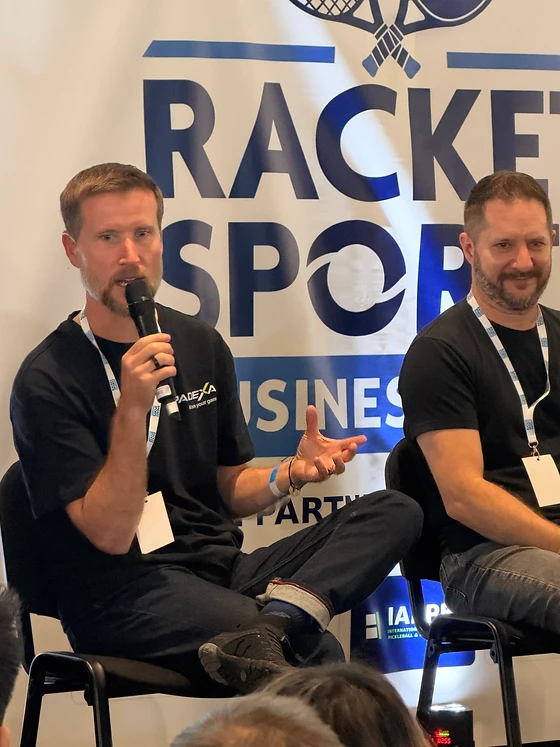
This morning I sat on the first seminar panel at the first Racket Sports Business Expo. The brief: practical AI for smarter racket sports businesses. The room was operators, coaches, club owners and founders. Gareth Shaw builds OnCourt AI for tennis, Ben Baddeley-Chapman came from CourtReserve's world of club software in the US, Radoslav Sakenas works on retention for racket brands, and I was there for PADEXA. Emily Kilner kept us moving.
AI has to be joyful and useful.
Most AI talk is fear: will it take my job, my role, my club? My answer on stage: "it has to be two things for people: joyful and useful." AI is inert by nature. It has no purpose until we give it one. Start with the outcome you want, a player improving or a club understanding its retention, and work backwards from there. Before any tool arrives: "what are the right questions we should be asking in our businesses before we're then deploying technology?"
We all know software-as-a-service: an extension of something we already do, one instruction at a time. Agentic AI changes the deal. "What's the end goal I want, and then it creates all of those sub-routines, sub-components, and orchestrates it to get me the result." You don't buy software you have to work. You state the outcome and the finished thing arrives. That lets a club leapfrog stages that cost other industries years of frustration.
When they asked what I'd do with £1,000, I said: take people to lunch.
Ben split the money between acquisition and retention, and his reasoning was sound: "memberships are the bread and butter... you can't have churning members." Gareth automated three things: payments, the admin inbox, the club gate. Radoslav put every pound on retention.
I'd do none of that. "I would go and find other people that are doing things, and I'd spend that £1,000 on taking them out for lunch." Over a series of lunches, ask: "What's working, how are you doing it, where's your friction, and where are you getting flow?" A vendor's marketing post tells you what a tool does. An operator two courts ahead of you tells you what it's like on a Monday morning. Do that a few times and you have a peer group, everyone spending a little and reporting back, "everybody rises and co-elevates."
Follow-up should be easy, not a load of work.
Every business conversation at a show dies the same death: the notes, the warm intent, the follow-up you never quite do. Here's how mine went this week. At the networking the night before, I met a chap from the British Padel Coaching Association. One conversation, one idea: three months' access for their coaches, single-use codes, full match analysis. Walking back to my room, I dropped one voice note into my agents: get it set up, three months' access for my coaches, single use, we'll plug it in this way.
By the morning it had built the deck, a video version, the outreach email draft, the commercial model in token costs, and the full build scope, ready to show him. Historically that's a developer, a team and a personal assistant, over a week. The lesson for any business: follow-up friction is now a choice. Whoever you met in the aisle today, the follow-up can be waiting tomorrow.
The in-between is the opportunity.
Admin will go where admin goes. The future is already here, just not evenly distributed, and what stays is discernment: a completely humanless experience, or Alice at the front desk and the whole club on socials. Both are choices. The music industry asked itself whether digital would stop people going to gigs, and the answer turned out to be the opposite. Same question for us: "in between the moments, we need to give opportunity for belonging and connection in between the games and the matches." That's WhatsApp groups, socials, the club community around the play. Technology can open up what goes on inside the courts, and belonging gets built in between.

Metric, meaning, action.
Clubs are drowning in dashboards. "A metric to meaning to action." Overwhelmed with data but no meaning and no action doesn't help. The panel's most practical minutes were about where the real data lives. In padel the de facto booking layer isn't a booking system, it's the WhatsApp group: court for six, got three, need one more, needs to be intermediate. So we built a free tool for exactly that. Export the group chat, drop it in, sixty seconds later you know how many games were asked for, how many died, when and why, and what to post on Monday. Live now, and the chat never leaves your browser: padexa.ai/missed-games.
Radoslav's version costs nothing at all: export four months of bookings, call the ten players whose frequency dropped most, and you'll learn more about your retention than any dashboard will tell you. Ben's number to watch is revenue per player, the single signal of whether your club is growing, stalling or declining. And Gareth's is the habit: film your group, send each player one thing to improve that week.
Start with low-risk reps.
If you take one thing from me: "look for an area where it's low risk, start to experiment, be curious." One workflow. A WhatsApp group, one match, one follow-up. Confidence compounds from there, until saying "do this, miss the agent, build my deck" is just how Tuesday works. Before agents, there's a half-step: set up your brand guidelines as a project or a skill, "so what comes out doesn't need two or three more prompts to get it right, and it comes out on-brand, on-colour, right voice, right tone every time."
And as I said on stage, only half joking: if you play padel, your first full match analysis is free. If you love the game, The Little Book of Padel is out now.

IF YOU PLAY PADEL — your first full match analysis is free.
IF YOU LOVE THE GAME — The Little Book of Padel is out now.